210
18 days ago
The Original Affordable Royal Oak Alternative Is Now Even Better
Summary
Getting better all the time.
If you buy from a link, we may earn a commission. Learn more
There is no shortage of affordable alternatives to the Audemars Piguet Royal Oak floating around the watch industry these days, from the Tissot PRX and the Christopher Ward Twelve to the Maurice Lacroix Aikon and Alpina Alpiner Extreme.
Most of these alternatives have only popped up in the last decade as the Royal Oak‘s popularity has exploded. But not the Nivada Grenchen F77. Nivada was producing affordable AP alternatives before it was cool, with the original F77 — which features a bezel and dial very reminiscent of the Royal Oak — debuting just five years after the Genta-designed icon in 1977.
Last summer, Nivada unveiled a new generation of the F77, the MKII, with a slimmer case, drilled and reshaped lugs that allow for a more natural drape of the bracelet, and a reworked bracelet.
However, the watch debuted with just one dial option: black onyx stone. Now, Nivada has properly rolled out an entire line of F77 MKIIs, including some that are dead ringers for the Royal Oak.
The new range of F77 watches is all about the dials.
The stainless steel MKII case, with its 38mm diameter and 12.2mm thickness, and the reworked lugs and bracelet are all the same as on the onyx model that debuted in July. Also unchanged is the Soprod Calibre P024 automatic powering the watch.
What is new are the dial options, and there are a bunch of them. Eight, to be exact, split evenly across two categories: Stone dials and Tressed, which is a three-dimensional basketweave pattern.
Starting with the stone dials, you can choose from Meteorite, Lapis Lazuli, Dark Blue Aventurine and Green Aventurine. The meteorite here is dark gray, almost black in appearance, while the lapis is the stone’s typical brilliant blue with white and gold inflections. It’s easy to see why this stone has become so popular among watch brands in recent years.
What I find most interesting here is the use of both kinds of aventurine. The vast majority of “aventurine” watch dials aren’t made with a natural stone but rather with aventurine glass, which is dark blue or black glass with copper flecks in it, making it resemble the night sky. That’s the material used for the Dark Blue Aventurine F77.
Far rarer to see on a watch dial is natural aventurine, which looks nothing like its Venetian-invented homonym. It’s a medium green stone with some sparkly inclusions, but it looks far earthier, more natural and less ethereal than aventurine glass. It’s less visually mesmerizing, in my opinion, but if you’re all about natural looks, then you may prefer it.
All four of the stone-dial options also carry over the dressier dauphine handset that was introduced on the onyx-dial MkII last year.
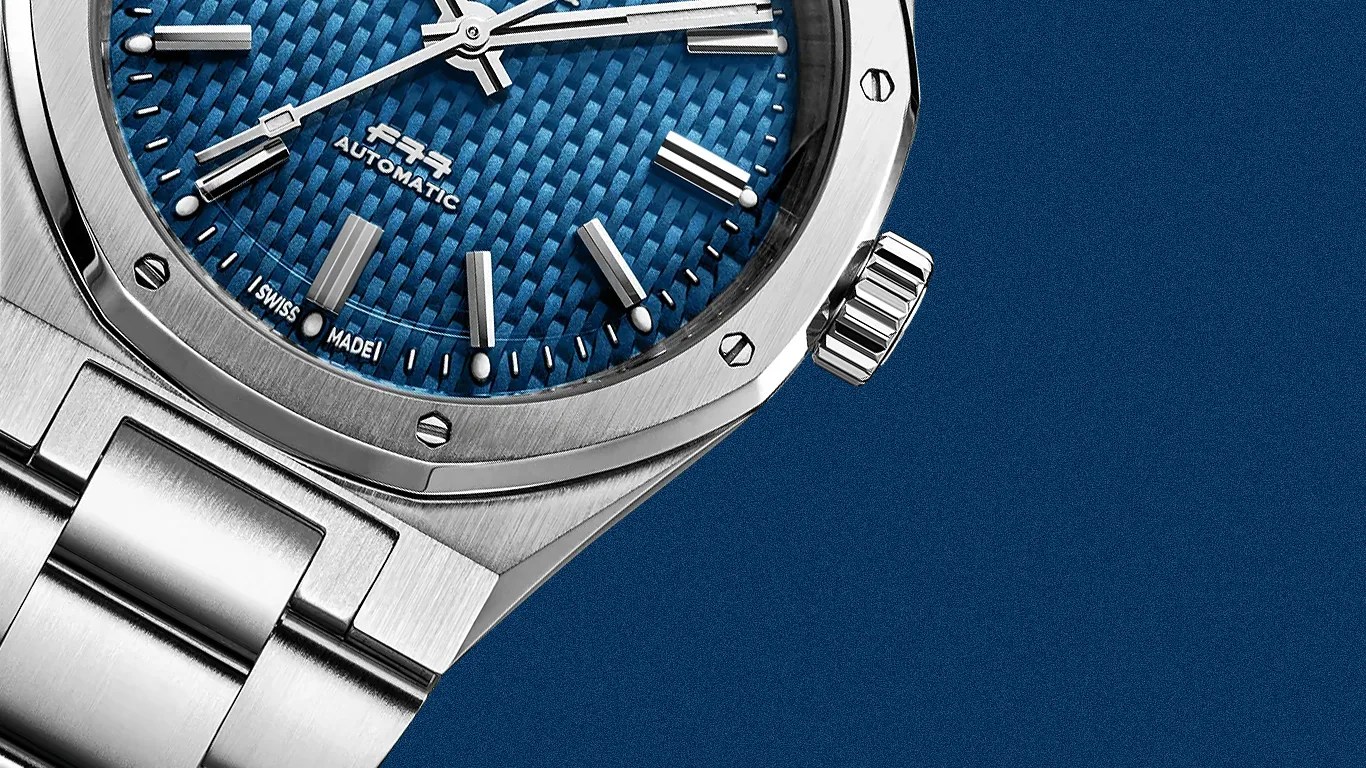
The Tressed dials are where most people in search of a cheaper Royal Oak will turn, as their basketweave pattern is quite similar to AP’s famous waffle-like Tapisserie dial.
They also bring back the original baton handset, which is more faithful to the original F77, more similar to the Royal Oak’s handset and a better visual match to the watch’s baton indices. This also means more lume, as all three hands feature green-emission Super-LumiNova along with the lume plots outside each index. The stone-dial versions only feature the lume plots, with no lume on the hands, which doesn’t make a lot of sense.
There are four color options for the Tressed dial: White, Gray, Black and Blue. Black and Gray are very similar in appearance, and I would’ve preferred to see one of them swapped out with something more interesting — green, perhaps — but both the white and blue look great. Blue certainly reads more “Royal Oak,” but this isn’t Bleu Nuit, Nuage 50 — it’s a brighter, more electric blue that’s quite fun.
Lastly, the Tressed options are the only way you can get a date. All colors are available in both date and no-date options, while the Stone dials only come sans date.
All of Nivada’s new F77 references are available on either an integrated canvas Velcro or rubber strap if you don’t want the bracelet, and you’ll save some money going with a strap option, too.
All versions, save for the Green Aventurine, start at $1,160 on either strap. The Tressed dials go for $1,360 on the bracelet, while the Lapis, Meteorite and Dark Blue Aventurine are all priced at $1,560 on the bracelet. This seems like a pricing error on Nivada’s website to me, as it’s the same bracelet on all models, so I don’t see why the stone dials would cost more on the bracelet but not on the strap. I assume the stone dial strap price is currently too low.
I’m guessing the correct pricing for all stone dials is what’s shown for the Green Aventurine version, which retails for $1,360 on the strap and $1,560 on the bracelet. I’ve reached out to Nivada for clarification on the price discrepancy.
Johnny Brayson is an editor at Gear Patrol mostly covering watches. He enjoys watches that are packed with blink-and-you’ll-miss-’em details and believes nearly every watch could stand to be a tad smaller.
Want to stay up to date on the latest product news and releases? Add Gear Patrol as a preferred source to ensure our independent journalism makes it to the top of your Google search results.
Founded in 2007, Gear Patrol is the definitive buying guide for enthusiasts. Our independent experts test the best in cars, tech, home, outdoors, style and watches. We combine hands-on testing, decades of experience and original photography to craft reports, reviews and guides. Why? Because we believe everyone deserves the best product.
Work with our award-winning creative services studio and advertising agency to bring your brand or product story to life. Learn more.
© 2026 GPS Media - Guides, Products, Services | For Life's Pursuits™
If you buy from a link, we may earn a commission. Learn more
There is no shortage of affordable alternatives to the Audemars Piguet Royal Oak floating around the watch industry these days, from the Tissot PRX and the Christopher Ward Twelve to the Maurice Lacroix Aikon and Alpina Alpiner Extreme.
Most of these alternatives have only popped up in the last decade as the Royal Oak‘s popularity has exploded. But not the Nivada Grenchen F77. Nivada was producing affordable AP alternatives before it was cool, with the original F77 — which features a bezel and dial very reminiscent of the Royal Oak — debuting just five years after the Genta-designed icon in 1977.
Last summer, Nivada unveiled a new generation of the F77, the MKII, with a slimmer case, drilled and reshaped lugs that allow for a more natural drape of the bracelet, and a reworked bracelet.
However, the watch debuted with just one dial option: black onyx stone. Now, Nivada has properly rolled out an entire line of F77 MKIIs, including some that are dead ringers for the Royal Oak.
The new range of F77 watches is all about the dials.
The stainless steel MKII case, with its 38mm diameter and 12.2mm thickness, and the reworked lugs and bracelet are all the same as on the onyx model that debuted in July. Also unchanged is the Soprod Calibre P024 automatic powering the watch.
What is new are the dial options, and there are a bunch of them. Eight, to be exact, split evenly across two categories: Stone dials and Tressed, which is a three-dimensional basketweave pattern.
Starting with the stone dials, you can choose from Meteorite, Lapis Lazuli, Dark Blue Aventurine and Green Aventurine. The meteorite here is dark gray, almost black in appearance, while the lapis is the stone’s typical brilliant blue with white and gold inflections. It’s easy to see why this stone has become so popular among watch brands in recent years.
What I find most interesting here is the use of both kinds of aventurine. The vast majority of “aventurine” watch dials aren’t made with a natural stone but rather with aventurine glass, which is dark blue or black glass with copper flecks in it, making it resemble the night sky. That’s the material used for the Dark Blue Aventurine F77.
Far rarer to see on a watch dial is natural aventurine, which looks nothing like its Venetian-invented homonym. It’s a medium green stone with some sparkly inclusions, but it looks far earthier, more natural and less ethereal than aventurine glass. It’s less visually mesmerizing, in my opinion, but if you’re all about natural looks, then you may prefer it.
All four of the stone-dial options also carry over the dressier dauphine handset that was introduced on the onyx-dial MkII last year.
The Tressed dials are where most people in search of a cheaper Royal Oak will turn, as their basketweave pattern is quite similar to AP’s famous waffle-like Tapisserie dial.
They also bring back the original baton handset, which is more faithful to the original F77, more similar to the Royal Oak’s handset and a better visual match to the watch’s baton indices. This also means more lume, as all three hands feature green-emission Super-LumiNova along with the lume plots outside each index. The stone-dial versions only feature the lume plots, with no lume on the hands, which doesn’t make a lot of sense.
There are four color options for the Tressed dial: White, Gray, Black and Blue. Black and Gray are very similar in appearance, and I would’ve preferred to see one of them swapped out with something more interesting — green, perhaps — but both the white and blue look great. Blue certainly reads more “Royal Oak,” but this isn’t Bleu Nuit, Nuage 50 — it’s a brighter, more electric blue that’s quite fun.
Lastly, the Tressed options are the only way you can get a date. All colors are available in both date and no-date options, while the Stone dials only come sans date.
All of Nivada’s new F77 references are available on either an integrated canvas Velcro or rubber strap if you don’t want the bracelet, and you’ll save some money going with a strap option, too.
All versions, save for the Green Aventurine, start at $1,160 on either strap. The Tressed dials go for $1,360 on the bracelet, while the Lapis, Meteorite and Dark Blue Aventurine are all priced at $1,560 on the bracelet. This seems like a pricing error on Nivada’s website to me, as it’s the same bracelet on all models, so I don’t see why the stone dials would cost more on the bracelet but not on the strap. I assume the stone dial strap price is currently too low.
I’m guessing the correct pricing for all stone dials is what’s shown for the Green Aventurine version, which retails for $1,360 on the strap and $1,560 on the bracelet. I’ve reached out to Nivada for clarification on the price discrepancy.
Johnny Brayson is an editor at Gear Patrol mostly covering watches. He enjoys watches that are packed with blink-and-you’ll-miss-’em details and believes nearly every watch could stand to be a tad smaller.
Want to stay up to date on the latest product news and releases? Add Gear Patrol as a preferred source to ensure our independent journalism makes it to the top of your Google search results.
Founded in 2007, Gear Patrol is the definitive buying guide for enthusiasts. Our independent experts test the best in cars, tech, home, outdoors, style and watches. We combine hands-on testing, decades of experience and original photography to craft reports, reviews and guides. Why? Because we believe everyone deserves the best product.
Work with our award-winning creative services studio and advertising agency to bring your brand or product story to life. Learn more.
© 2026 GPS Media - Guides, Products, Services | For Life's Pursuits™
AI Description
The article discusses the expansion of Nivada Grenchen's F77 sports watch line, which offers an affordable alternative to the Audemars Piguet Royal Oak. The second generation of this 1970s-inspired watch now includes a wider range of models.