310
18 days ago
Merz in China: German chancellor, Xi seek more cooperation
Summary
Friedrich Merz said he saw a "great opportunity" for the industrial exporters, while Xi Jinping called for "enhanced strategic cooperation." China has been courting Western leaders amid Trump's trade tensions.
This blog is now closed. Catch up on DW's coverage of German Chancellor Friedrich Merz's trip to China below.
German Chancellor Friedrich Merz Thursday completed his inaugural trip to China with a host of business leaders. Here are four takeaways from the trip:
Economy: Merz told reporters that economic competition "played an important role" in conversations during his trip. He addressed the economic imbalance and said the "dynamic was not healthy."
Merz held separate discussions with Chinese leader Xi Jinping and Chinese Premier Li Qiang on Wednesday.
Airbus order: China is set to buy up to 120 additional Airbus aircraft. Merz touted the importance of his trip, saying the deal shows "how worthwhile such trips can be."
Ukraine war: Merz raised the issue with Chinese leaders, saying he urged Beijing to exert more influence on its ally Russia to end the war in Ukraine.
"Signals from China are taken very seriously in Moscow," Merz said. "China's voice is heard in the world."
United front amid divisions with US: Germany's conservative leader went to China after British, French and Canadian leaders traveled to Beijing in recent months.
As Chancellor Friedrich Merz wraps his inaugural visit to China, here is a look at what the German leader was trying to achieve.
Merz's first official trip to China was:
A drive to attract Chinese investment in Germany and better market access for German companies
A shift from a China hawk to a chancellor seeking a relationship reset that moves toward 'strategic partnership'
A tightrope for the leader of Europe's largest economy; balancing his economic interests between EU and US expectations
Another balancing act between recognizing China’s new might while highlighting that this also comes with responsibilities
An attempt to get China to clamp down on Russia; Merz is hopeful, but not optimistic, that China will help end the war on Ukraine
A departure from common practices by former chancellors Scholz and Merkel; Merz took no on-the-record questions from journalists, a move his predecessors would often make to demonstrate media freedom to China
German Chancellor Friedrich Merz said his talks with Chinese President Xi Jinping were successful, but he still acknowledged remaining challenges.
"Above all, there are issues relating to competition - China has high capacities, some of which are now also posing a problem for Europe because they far exceed market demand," he told reporters in Hangzhou at the end of his visit to the tech hub.
The German chancellor said he would ask Economy Minister Katherina Reiche to visit China as well, adding that the challenges he listed will have to be discussed "in detail after my visit."
In 2024, the European Union slammed China with tariffs on its electronic vehicles, arguing that Chinese subsidies hurt the competition at home. China has long rejected such tariffs.
To view this video please enable JavaScript, and consider upgrading to a web browser that supports HTML5 video
During his trip to China on Thursday, German Chancellor Friedrich Merz raised the issue of the ongoing war in Ukraine with Chinese President Xi Jinping.
Merz spoke of ending the war, which marked its fourth anniversary earlier this week. The German chancellor said he hoped he was able to convey to his Chinese counterpart the importance of such a step.
Xi said diplomacy was "key to the issue," according to Chinese state agency Xinhua.
Russia has inched closer to China since launching its fullscale invasion of Ukraine in February 2022, with Western countries arguing Beijing has enough leverage to influence Moscow.
Ukrainian President Volodymyr Zelenskyy has often blamed China for supporting Russia.
To view this video please enable JavaScript, and consider upgrading to a web browser that supports HTML5 video
German Chancellor Friedrich Merz wants to reset ties with China amid global uncertainty.
During his first official trip to China, Merz has highlighted long‑standing economic cooperation with its largest trading partner. Chinese President Xi Jinping has called for stronger strategic communication and trust, underpinning the importance of stable China‑Germany relations for Europe and global stability.
To view this video please enable JavaScript, and consider upgrading to a web browser that supports HTML5 video
The German Football League (DFL) and China Media Group (CMG) reaffirmed their long-standing media partnership during Chancellor Friedrich Merz's maiden trip to Beijing.
The parties on Wednesday signed a joint memorandum of understanding (MoU) to extend their TV contract, in the presence of Merz and Chinese Premier Li Qiang.
Alongside the MoU, DFL Managing Director Steffen Merkel and CMG President Shen Haixiong also agreed to further areas of cooperation, including the promotion of young football talent.
CMG is China’s largest national media group, which caters to billions of viewers with its programs.
The group's television station CCTV first broadcast Bundesliga matches in 1995.
CMG holds the broadcasting rights to the German elite league in China through the 2027-2028 season.
The Chinese market is of great interest for German football.
In 2019, the DFL opened an office in Beijing. Several Bundesliga clubs, including Bayern Munich and Borussia Dortmund, are also permanently active in China.
German Chancellor Friedrich Merz visited the Chinese tech hub of Hangzhou on Thursday, accompanied by a delegation of German entrepreneurs including representatives of auto giants Volkswagen, BMW and Mercedes.
Hangzhou, a tech hub of 12.6 million people, is home to several major Chinese tech firms like artificial intelligence company DeepSeek, e-commerce giant Alibaba and humanoid robot-maker Unitree — as well as Germany's Siemens Energy.
Many European business leaders have complained that China is flooding the EU market with cheap goods and have urged Merz to keep a cavernous trade imbalance at the top of his agenda.
Germany's own trade deficit with China hit a record €89 billion ($105 billion) last year.
During his visit to China, Chancellor Friedrich Merz is keen to deepen economic links between Germany and the world's second-largest economy, which recently overtook the United States as Germany's most important trading partner.
But China is also a major competitor for Germany, especially in the mechanical, chemical and car industries. And back home, the famous Mittelstand, the almost four million small-to-medium-sized businesses which have traditionally formed the backbone of the German economy, are feeling the pressure.
According to a new study from the state-owned German investment and development bank KfW, almost one in five of those companies (19%) say they are facing increasing competition from China. And not only in terms of pricing, but increasingly in terms of quality, too.
"The probability that a company is looking pessimistically towards the future increases sharply if they have direct competitors in China," writes the bank, which listed the biggest hurdles facing German companies as bureaucracy (a problem for 65%), high taxation (60%) and expensive energy (41%) — ratings which are all up considerably since 2023.
However, many medium-sized companies also benefit from trade with China: around 19% of small and medium-sized enterprises said they now use Chinese imports to save costs or improve their own product range.
Chancellor Merz will be bearing that in mind during his visits on Thursday.
Guten Morgen! Welcome back to DW's coverage of German Chancellor Friedrich Merz's visit to China.
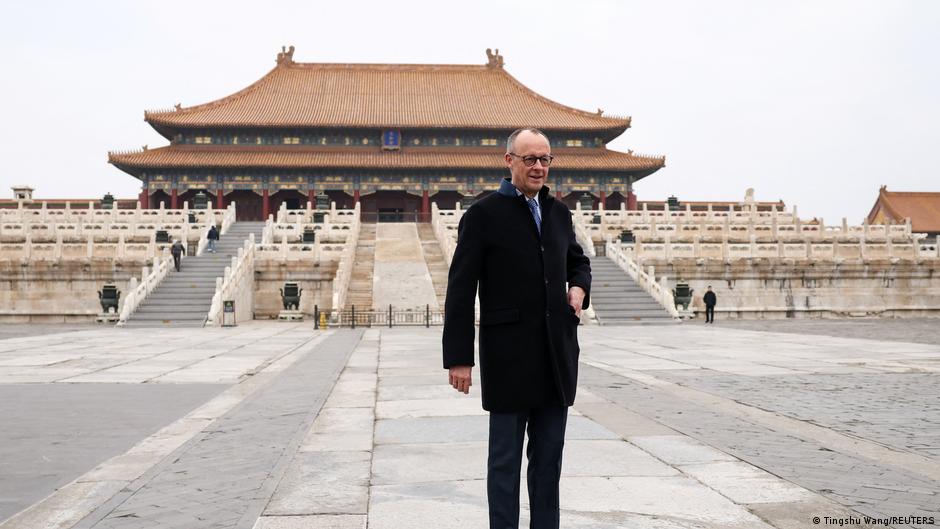
On the second day of his trip, Chancellor Merz visited the Forbidden City in Beijing, which served as the palace of China's emperors for over 500 years.
In his entry in the visitors' book, Merz wished both Germany and China "speed, power and energy in a year of cooperation and growth."
At least barring unforeseen developments in the coming hours while most of China is fast asleep, we'll be putting our coverage on hold for a few hours now.
So let's take stock of the arguably banner day of Chancellor Merz's first trip to the world's second-largest economy since taking office:
As for what's on the docket for Thursday in China, here are a few points of potential interest:
Chinese state news agency Xinhua carried a brief response from Xi to Merz's call for China to bring its influence to bear on Moscow in a bid to bring an end to Russia's invasion of Ukraine.
According to Xinhua, Xi told the German chancellor that diplomacy was "key to the issue" of halting the war with open Russian participation, which entered its fifth year as of Tuesday.
"Xi noted the necessity of ensuring the equal participation of all parties to lay a solid foundation for peace, [and] addressing the legitimate concerns of all sides to strengthen the will for peace," Xinhua wrote.
Both Russia and Ukraine have at times complained that their voices and grievances are not adequately heard or taken into account in the various efforts at diplomacy in recent years.
Representatives from the US, Russia and Ukraine are scheduled for more meetings on Thursday in Geneva.
With Wednesday's business in Beijing winding down, Reuters news agency cites German government sources as saying that Merz raised some trickier economic topics directly in his talks with Premier Li Qiang.
"The chancellor brought up trade restrictions, the rapidly rising trade deficit, currency questions and rare earths during his discussion with Li," Reuters cited its sources as saying. "It was made clear that China must also deliver if it wants to reinforce its image as a partner that sticks to the rules."
This phrasing could be interpreted both as a nod to the Trump administration in the US and to China's recent allusions to itself as a reliable partner, which have largely been seen as a bid to contrast the often-changing trade stance coming from the White House in recent weeks and months.
Raising these questions with Li rather than President Xi Jinping could be because Li's role is nominally more closely concerned with domestic and economic policy and day-to-day government operations than his superior Xi's more overarching position as head of state.
Merz said in Beijing that although "our political systems are fundamentally different" and "both sides are aware that we can also reach differing positions on important questions," Germany and China could nevertheless cooperate to mutual benefit in many areas.
"That demands patience and above all it demands dialogue," Merz said.
Mercedes-Benz has lauded Merz's trip to "one of the most important markets" for the company and the car industry as a whole, seemingly encouraging more political engagement between Berlin and Beijing.
German carmakers' difficulties in 2025 were attributable in very large part to deteriorating performance in their two main export markets, the United States and China.
"From Mercedes-Benz's perspective as well, personal exchange remains highly important in promoting mutual understanding and continuing to work on maintaining positive economic relations," a company spokesperson said.
The spokesperson said the German government was demonstrating "that bilateral exchange and the cultivation of political and economic relations between the countries are a high priority."
Merz said on Wednesday that a new date for the next set of bilateral government-level consultations would be announced soon. He also said he planned regular visits to China as chancellor.
"I place high value on maintaining and also deepening these [ties], wherever it's possible," he said during his meeting with Premier Li Qiang.
Looking for a longer exploration of modern China, how state planning is accelerating modernization, and how it's using key materials like rare earths to create systemic dependencies?
Interested in its bid to increase its already sizeable footprint in Europe, often using Viktor Orban's Hungary as a base, and an analysis of how dependent on China Germany has really become?
If so, take a look at this featured long video "Economic Powerhouse China — A Risky Partner?"
Experts from Europe, the US and China also provide insights and answers on how China stacks up against the United States, the other global superpower it has emerged to challenge in recent decades.
To view this video please enable JavaScript, and consider upgrading to a web browser that supports HTML5 video
Merz also told reporters in Beijing that he had raised the issue of Taiwan during his talks.
He said that Germany's China politics remained unchanged. In other words, this means that Germany — like almost every major country on the planet — continues to adhere to the "one China" principle Beijing insists on that formally recognizes Taiwan as an inalienable part of Chinese territory and does not recognize Taiwan as a fully-fledged state.
Holding this position is a precondition for having full diplomatic relations with China; even Taiwan's most important ally the US keeps to it.
However, Merz also issued a warning against any efforts to take Taiwan by military force, a possibility Beijing has never ruled out if also a path it has never pursued against the democratic island nation.
"Any attempt at a reunification or unification between China and Taiwan can only succeed via peaceful means and not with military action," he said.
To view this video please enable JavaScript, and consider upgrading to a web browser that supports HTML5 video
This blog is now closed. Catch up on DW's coverage of German Chancellor Friedrich Merz's trip to China below.
German Chancellor Friedrich Merz Thursday completed his inaugural trip to China with a host of business leaders. Here are four takeaways from the trip:
Economy: Merz told reporters that economic competition "played an important role" in conversations during his trip. He addressed the economic imbalance and said the "dynamic was not healthy."
Merz held separate discussions with Chinese leader Xi Jinping and Chinese Premier Li Qiang on Wednesday.
Airbus order: China is set to buy up to 120 additional Airbus aircraft. Merz touted the importance of his trip, saying the deal shows "how worthwhile such trips can be."
Ukraine war: Merz raised the issue with Chinese leaders, saying he urged Beijing to exert more influence on its ally Russia to end the war in Ukraine.
"Signals from China are taken very seriously in Moscow," Merz said. "China's voice is heard in the world."
United front amid divisions with US: Germany's conservative leader went to China after British, French and Canadian leaders traveled to Beijing in recent months.
As Chancellor Friedrich Merz wraps his inaugural visit to China, here is a look at what the German leader was trying to achieve.
Merz's first official trip to China was:
A drive to attract Chinese investment in Germany and better market access for German companies
A shift from a China hawk to a chancellor seeking a relationship reset that moves toward 'strategic partnership'
A tightrope for the leader of Europe's largest economy; balancing his economic interests between EU and US expectations
Another balancing act between recognizing China’s new might while highlighting that this also comes with responsibilities
An attempt to get China to clamp down on Russia; Merz is hopeful, but not optimistic, that China will help end the war on Ukraine
A departure from common practices by former chancellors Scholz and Merkel; Merz took no on-the-record questions from journalists, a move his predecessors would often make to demonstrate media freedom to China
German Chancellor Friedrich Merz said his talks with Chinese President Xi Jinping were successful, but he still acknowledged remaining challenges.
"Above all, there are issues relating to competition - China has high capacities, some of which are now also posing a problem for Europe because they far exceed market demand," he told reporters in Hangzhou at the end of his visit to the tech hub.
The German chancellor said he would ask Economy Minister Katherina Reiche to visit China as well, adding that the challenges he listed will have to be discussed "in detail after my visit."
In 2024, the European Union slammed China with tariffs on its electronic vehicles, arguing that Chinese subsidies hurt the competition at home. China has long rejected such tariffs.
To view this video please enable JavaScript, and consider upgrading to a web browser that supports HTML5 video
During his trip to China on Thursday, German Chancellor Friedrich Merz raised the issue of the ongoing war in Ukraine with Chinese President Xi Jinping.
Merz spoke of ending the war, which marked its fourth anniversary earlier this week. The German chancellor said he hoped he was able to convey to his Chinese counterpart the importance of such a step.
Xi said diplomacy was "key to the issue," according to Chinese state agency Xinhua.
Russia has inched closer to China since launching its fullscale invasion of Ukraine in February 2022, with Western countries arguing Beijing has enough leverage to influence Moscow.
Ukrainian President Volodymyr Zelenskyy has often blamed China for supporting Russia.
To view this video please enable JavaScript, and consider upgrading to a web browser that supports HTML5 video
German Chancellor Friedrich Merz wants to reset ties with China amid global uncertainty.
During his first official trip to China, Merz has highlighted long‑standing economic cooperation with its largest trading partner. Chinese President Xi Jinping has called for stronger strategic communication and trust, underpinning the importance of stable China‑Germany relations for Europe and global stability.
To view this video please enable JavaScript, and consider upgrading to a web browser that supports HTML5 video
The German Football League (DFL) and China Media Group (CMG) reaffirmed their long-standing media partnership during Chancellor Friedrich Merz's maiden trip to Beijing.
The parties on Wednesday signed a joint memorandum of understanding (MoU) to extend their TV contract, in the presence of Merz and Chinese Premier Li Qiang.
Alongside the MoU, DFL Managing Director Steffen Merkel and CMG President Shen Haixiong also agreed to further areas of cooperation, including the promotion of young football talent.
CMG is China’s largest national media group, which caters to billions of viewers with its programs.
The group's television station CCTV first broadcast Bundesliga matches in 1995.
CMG holds the broadcasting rights to the German elite league in China through the 2027-2028 season.
The Chinese market is of great interest for German football.
In 2019, the DFL opened an office in Beijing. Several Bundesliga clubs, including Bayern Munich and Borussia Dortmund, are also permanently active in China.
German Chancellor Friedrich Merz visited the Chinese tech hub of Hangzhou on Thursday, accompanied by a delegation of German entrepreneurs including representatives of auto giants Volkswagen, BMW and Mercedes.
Hangzhou, a tech hub of 12.6 million people, is home to several major Chinese tech firms like artificial intelligence company DeepSeek, e-commerce giant Alibaba and humanoid robot-maker Unitree — as well as Germany's Siemens Energy.
Many European business leaders have complained that China is flooding the EU market with cheap goods and have urged Merz to keep a cavernous trade imbalance at the top of his agenda.
Germany's own trade deficit with China hit a record €89 billion ($105 billion) last year.
During his visit to China, Chancellor Friedrich Merz is keen to deepen economic links between Germany and the world's second-largest economy, which recently overtook the United States as Germany's most important trading partner.
But China is also a major competitor for Germany, especially in the mechanical, chemical and car industries. And back home, the famous Mittelstand, the almost four million small-to-medium-sized businesses which have traditionally formed the backbone of the German economy, are feeling the pressure.
According to a new study from the state-owned German investment and development bank KfW, almost one in five of those companies (19%) say they are facing increasing competition from China. And not only in terms of pricing, but increasingly in terms of quality, too.
"The probability that a company is looking pessimistically towards the future increases sharply if they have direct competitors in China," writes the bank, which listed the biggest hurdles facing German companies as bureaucracy (a problem for 65%), high taxation (60%) and expensive energy (41%) — ratings which are all up considerably since 2023.
However, many medium-sized companies also benefit from trade with China: around 19% of small and medium-sized enterprises said they now use Chinese imports to save costs or improve their own product range.
Chancellor Merz will be bearing that in mind during his visits on Thursday.
Guten Morgen! Welcome back to DW's coverage of German Chancellor Friedrich Merz's visit to China.
On the second day of his trip, Chancellor Merz visited the Forbidden City in Beijing, which served as the palace of China's emperors for over 500 years.
In his entry in the visitors' book, Merz wished both Germany and China "speed, power and energy in a year of cooperation and growth."
At least barring unforeseen developments in the coming hours while most of China is fast asleep, we'll be putting our coverage on hold for a few hours now.
So let's take stock of the arguably banner day of Chancellor Merz's first trip to the world's second-largest economy since taking office:
As for what's on the docket for Thursday in China, here are a few points of potential interest:
Chinese state news agency Xinhua carried a brief response from Xi to Merz's call for China to bring its influence to bear on Moscow in a bid to bring an end to Russia's invasion of Ukraine.
According to Xinhua, Xi told the German chancellor that diplomacy was "key to the issue" of halting the war with open Russian participation, which entered its fifth year as of Tuesday.
"Xi noted the necessity of ensuring the equal participation of all parties to lay a solid foundation for peace, [and] addressing the legitimate concerns of all sides to strengthen the will for peace," Xinhua wrote.
Both Russia and Ukraine have at times complained that their voices and grievances are not adequately heard or taken into account in the various efforts at diplomacy in recent years.
Representatives from the US, Russia and Ukraine are scheduled for more meetings on Thursday in Geneva.
With Wednesday's business in Beijing winding down, Reuters news agency cites German government sources as saying that Merz raised some trickier economic topics directly in his talks with Premier Li Qiang.
"The chancellor brought up trade restrictions, the rapidly rising trade deficit, currency questions and rare earths during his discussion with Li," Reuters cited its sources as saying. "It was made clear that China must also deliver if it wants to reinforce its image as a partner that sticks to the rules."
This phrasing could be interpreted both as a nod to the Trump administration in the US and to China's recent allusions to itself as a reliable partner, which have largely been seen as a bid to contrast the often-changing trade stance coming from the White House in recent weeks and months.
Raising these questions with Li rather than President Xi Jinping could be because Li's role is nominally more closely concerned with domestic and economic policy and day-to-day government operations than his superior Xi's more overarching position as head of state.
Merz said in Beijing that although "our political systems are fundamentally different" and "both sides are aware that we can also reach differing positions on important questions," Germany and China could nevertheless cooperate to mutual benefit in many areas.
"That demands patience and above all it demands dialogue," Merz said.
Mercedes-Benz has lauded Merz's trip to "one of the most important markets" for the company and the car industry as a whole, seemingly encouraging more political engagement between Berlin and Beijing.
German carmakers' difficulties in 2025 were attributable in very large part to deteriorating performance in their two main export markets, the United States and China.
"From Mercedes-Benz's perspective as well, personal exchange remains highly important in promoting mutual understanding and continuing to work on maintaining positive economic relations," a company spokesperson said.
The spokesperson said the German government was demonstrating "that bilateral exchange and the cultivation of political and economic relations between the countries are a high priority."
Merz said on Wednesday that a new date for the next set of bilateral government-level consultations would be announced soon. He also said he planned regular visits to China as chancellor.
"I place high value on maintaining and also deepening these [ties], wherever it's possible," he said during his meeting with Premier Li Qiang.
Looking for a longer exploration of modern China, how state planning is accelerating modernization, and how it's using key materials like rare earths to create systemic dependencies?
Interested in its bid to increase its already sizeable footprint in Europe, often using Viktor Orban's Hungary as a base, and an analysis of how dependent on China Germany has really become?
If so, take a look at this featured long video "Economic Powerhouse China — A Risky Partner?"
Experts from Europe, the US and China also provide insights and answers on how China stacks up against the United States, the other global superpower it has emerged to challenge in recent decades.
To view this video please enable JavaScript, and consider upgrading to a web browser that supports HTML5 video
Merz also told reporters in Beijing that he had raised the issue of Taiwan during his talks.
He said that Germany's China politics remained unchanged. In other words, this means that Germany — like almost every major country on the planet — continues to adhere to the "one China" principle Beijing insists on that formally recognizes Taiwan as an inalienable part of Chinese territory and does not recognize Taiwan as a fully-fledged state.
Holding this position is a precondition for having full diplomatic relations with China; even Taiwan's most important ally the US keeps to it.
However, Merz also issued a warning against any efforts to take Taiwan by military force, a possibility Beijing has never ruled out if also a path it has never pursued against the democratic island nation.
"Any attempt at a reunification or unification between China and Taiwan can only succeed via peaceful means and not with military action," he said.
To view this video please enable JavaScript, and consider upgrading to a web browser that supports HTML5 video
AI Description
The article discusses the diplomatic engagement between Germany and China, highlighting economic cooperation opportunities. It reflects China's strategy to strengthen ties with Western nations amid trade tensions with the U.S.