210
11 days ago
Germany news: Top diplomat denies Berlin is joining Iran war
Summary
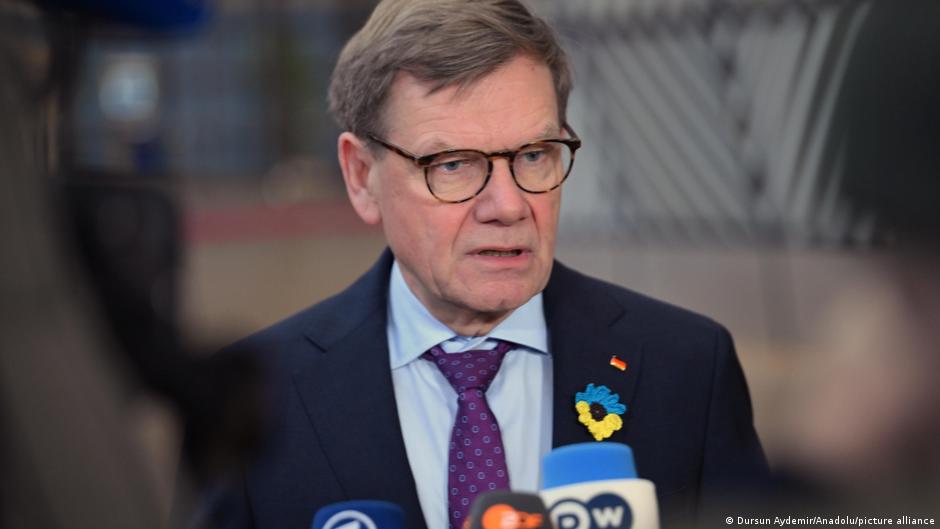
Foreign Minister Johann Wadephul has said Germany has "no intention of participating" in the conflict. Meanwhile, Chancellor Merz is set for talks with US President Trump. DW brings you the latest stories from Germany.
This blog is now closed. Read below for a roundup of the political and human interest stories making the headlines in Germany on Monday, March 2, 2026:
More than 450 flights have been canceled at Germany's major airports up to March 5 as a result of the conflict in the Middle East.
The German Airports Association (ADV) said the cancellations affected around 135,000 passengers and a number of destinations, including Doha, Dubai, Beirut, Tel Aviv and Abu Dhabi.
The US-Israeli strikes on Iran and Tehran's retaliatory attacks have left tens of thousands of travelers stranded in the region. There are around 30,000 tourists from Germany alone stuck there.
"The current developments in the Middle East clearly show how sensitive and vulnerable global traffic flows are to geopolitical crises," ADV Managing Director Ralph Beisel said, adding that safety was the main priority.
The ADV advised travelers to regularly check airline websites for information and heed the advice issued by the German Foreign Office.
The last time global flight traffic was disrupted on this scale was during the coronavirus pandemic.
Germany and France say they have set up a "high-ranking nuclear steering group" to boost cooperation on deterrence.
In a joint statement, French President Emmanuel Macron and German Chancellor Friedrich Merz said the agreement would see German troops participating in French nuclear exercises.
It would also involve coordination on conventional and missile-defense capabilities with European partners.
The two countries said their steering group would "add to, not substitute for, NATO's nuclear deterrence."
The announcement on Monday came after Macron said France would expand its nuclear arsenal as part of a plan to strengthen security in Europe.
Germany's Socialist Left Party sharply criticized the prospect of joint nuclear military exercises, saying it "increases the risk of becoming a preferred target."
To view this video please enable JavaScript, and consider upgrading to a web browser that supports HTML5 video
The German government says it is preparing to send civilian planes to Saudi Arabia and Oman to start evacuating nationals stranded due to the Iran war.
Up to 30,000 German tourists are believed to be stuck in the Middle East.
German Foreign Minister Johann Wadephul said vulnerable groups such as children, sick people and pregnant women would be flown out first.
He said he was in talks with national carrier Lufthansa to arrange the flights.
"The safety of our citizens is our top priority," Wadephul said.
The foreign minister added that crisis support teams would be sent to Muscat, Doha and Dubai to look into the possibility of evacuating Germans, including overland.
"Further teams are investigating the situation at the border crossings," he said, including a team from the German Embassy in Cairo assisting with crossings from Israel. "We have a common goal: we want to help Germans get home."
On the same day that German tour operators reported 30,000 customers stranded worldwide by airspace closures, German maritime companies said that thousands of cruise passengers were stuck in the Gulf.
The German shipowners' association (VDR) said that 25 ships belonging to seven different companies were affected, leaving some 7,000 passengers unable to pass through the Strait of Hormuz for security reasons.
Although the VDR didn't name any specific companies, Dertour and TUI Cruises announced earlier on Monday that they had suspended or changed travel plans across the Middle East.
The narrow waterway between Iran and Oman is one of the world's most critical oil shipping routes, carrying around 20% of global crude exports from the Gulf to markets in Europe, Asia and North America.
Iran's Revolutionary Guard has reportedly warned vessels not to pass amid the ongoing US-Israel war with Iran.
To view this video please enable JavaScript, and consider upgrading to a web browser that supports HTML5 video
A 36-year-old Syrian man whom prosecutors accuse of being a member of the terror group "Islamic State" (IS) has confessed in court to attacking celebrating football fans in front of a bar in the western German city of Bielefeld in May last year.
Four men were left with critical injuries after they were allegedly attacked by the suspect with a knife blade attached to a walking stick.
A psychiatric expert told the Düsseldorf Higher Regional Court on the first day of trial that the suspect considered the killing of "infidels" to be justified as part of a holy war or jihad.
The accused has told the psychiatrist that he had worked for IS only in the capacity of a real estate agent. Prosecutors assert that he received ideological and military training in Syria and took part in combat missions for the terrorist group.
He has been reported to regret his actions, saying he was depressed at the time of the attack because he suffered loneliness and marginalization in Germany, where he arrived in the summer of 2023.
The man, identified only as Mahmoud M. under German laws protecting the rights of suspects, has been charged with four counts of attempted murder.
The conflict in the Middle East is likely to cause energy prices to rise, with knock-on effects for the whole German economy, Economy Minister Katherina Reiche warned on Monday.
She told her ministry's annual policy conference in the eastern city of Halle that price increases were already apparent on the markets.
The duration of the conflict and its effects on important production facilities and transport routes would determine any further developments, she said.
According to Reiche, the situation in the Strait of Hormuz between Oman and Iran — a major global oil and gas transport route — was the main cause for concern.
Several shipping companies have suspended their operations through the Strait as a result of the US-Israeli war with Iran.
Reiche said that the German government had reactivated a task force put in place during the gas shortage at the start of Russia's ongoing invasion of Ukraine. But she said that it was currently just monitoring the situation and would intervene in the market only "if it is absolutely unavoidable."
However, she said she did not foresee short-term supply problems for Germany, as the country has successfully diversified its sources.
Germany's Lufthansa Group has said it is avoiding airspace over the Middle East amid the US-Israeli war with Iran, which has spilled over into several countries in the region.
The Lufthansa Group, which operates airlines such as the core Lufthansa brand, Swiss, Austrian Airlines, Eurowings, ITA Airways, Brussels Airlines and Lufthansa Cargo, said the "safety of passengers and crews is always the top priority."
It said its airlines would not use the airspace over Israel, Iran, Lebanon, Jordan, Iraq, Qatar, Kuwait, Bahrain and the Saudi airport of Dammam until at least March 8 and that over the United Arab Emirates until March 4.
Lufthansa said affected passengers can rebook to a later travel date free of charge or receive a full refund of the ticket price.
"As soon as the situation on the ground and the associated airspace closures allow, we will decide on additional flights from the region in order to be able to offer our guests a journey home as soon as possible," it said, but did not provide information on the numbers of people affected.
Tens of thousands of people on trips organized by German travel agencies have been affected by the war that has erupted in the Middle East, a leading trade group has said.
Figures from the German Travel Association suggest that some 30,000 tourists are unable to fly home amid the hostilities, which have prompted several countries in the region to close their airspace, while many airlines have put flights in and out of the crisis area on hold.
Travellers in the affected areas have been advised to follow safety instructions issued by the German Foreign Ministry and the guidelines issued by the local authorities.
One tour operator, Dertour, Germany's second-largest, said in a statement that "guests who are currently unable to fly home or are waiting for a connecting flight due to airspace closures have been informed by us and are being looked after on site."
"We will inform our guests on site about return journeys as soon as these are possible again and will accompany our guests on their transfer journeys," it said, adding that it had set up a crisis hotline.
The company has canceled all trips to the eight countries affected by the conflict until at least Thursday.
A German Defense Ministry spokesperson said on Monday that using military aircraft to evacuate German nationals stranded in the Middle East would be a last resort if all efforts to use commercial operators had been exhausted.
Around a quarter of employees in Germany work completely or partly from home, with the trend established during the 2020-2023 COVID-19 pandemic remaining stable, a leading economic institute has said.
The percentage of people working in what in German is known as "Homeoffice" was at 24.3% in February, the Munich-based Ifo Institute said, citing its most recent company survey.
"Individual companies that strongly restrict working from home are not starting any trend. Homeoffice is and remains established," Ifo researcher Jean-Victor Allipour said.
He said that although there were clear differences between sectors, the figure had remained fairly constant within the sectors themselves.
Service industries had the highest proportion of people working from home, with 76.4% of workers using the option at least sometimes.
In the field of consultancy, the figure was 67.6%,
The industrial sector had the lowest proportion of people working from home, at 15.4%, with the automobile sector having the highest rate (24.2%), along with manufactures of data processing devices (21.9%).
The lowest rate of work from home (WFH) was seen in the construction sector at 4.5%.
Almost six out of 10 people in Germany aged between 16 and 74 actively use social media on a private basis, new figures from the German Federal Statistical Office showed on Monday.
Although the statistics show a rise in social media use across all the age groups — from 47% in 2021 to 59% now — Germany almost brings up the rear in the EU, with only Italy having a smaller proportion of social media users, at 56%.
The EU average was 67%, with Denmark (90%), Cyprus (87%) and Malta (82%) leading the way.
The highest proportion of users in Germany was in the 16-24 age group, at 85%.
Just 25% of people aged 65-74 were active on social media, but here, too, a marked rise is evident compared with 2021, when the figure was 15%.
For the statistics, people were counted who had their own accounts or posted or engaged in interactions on social media platforms such as Instagram, Facebook, Tik Tok and X. Users of messaging platforms such as WhatsApp, Signal or Threema were not included.
People under 16 were not statistically presented.
Germany's highest court of civil and criminal jurisdiction, the Federal Court of Justice (BGH), is on Monday hearing two climate lawsuits brought against the carmakers BMW and Mercedes-Benz.
The lawsuits have been filed by advocacy group German Environmental Aid Association (DUH).
The group is seeking a ruling that would stop the two manufacturers from selling new vehicles driven by internal combustion engines — a major source of the CO2 pollution that is fueling global warming — from 2030.
It argues that BMW and Mercedes are using up too large a share of the global and national CO2 budget, which limits the scope for political action.
It says that by so doing, the companies would force governments to take stronger CO2 reduction measures that would be restrictive for their personal freedoms.
The court will have to decide on the key legal question of whether companies can be required to take climate-protective measures of their own accord, independently of government regulations.
Courts in Munich and Stuttgart, the two cities where BMW and Mercedes-Benz are respectively headquartered, have previously ruled against the environmental group. It wasn't initially clear whether the BGH would issue a ruling on Monday.
To view this video please enable JavaScript, and consider upgrading to a web browser that supports HTML5 video
German Foreign Minister Johann Wadephul has refuted Israeli media reports that Berlin would join the Iran war directly.
The German government "has no intention of participating," Wadephul told public broadcaster Deutschlandfunk. "We also do not have the necessary military resources," he added, with the caveat that Bundeswehr soldiers in Jordan and Iraq "would defend themselves if they were attacked."
The Times of Israel had reported that "German political and military sources" told Israel's Army Radio that Berlin was "seriously considering joining the US-Israel war with Iran," if Tehran did not stop attacks on neighboring countries.
German Chancellor Friedrich Merz is to set off for Washington on Monday, with talks with US President Donald Trump scheduled for the next day.
The visit, Merz's second official one to the White House, has been planned for some time.
However, the topics that were originally expected to dominate the discussions — the dispute between the US and the EU over tariffs and the Russian invasion of Ukraine — now seem likely to take a back seat to the conflict in the Middle East triggered by the US-Israel war with Iran.
Merz has made it clear that he will not be raising concerns about the legitimacy of the US-Israeli actions under international law, despite any misgivings he might have on the issue.
The German chancellor might, however, repeat his doubts to the US leader about whether the attacks on Iran will really bring about a democratic change in the Middle Eastern country.
To view this video please enable JavaScript, and consider upgrading to a web browser that supports HTML5 video
Despite the changed focus of the talks, US tariffs and Russia policy are still likely to be touched on, and Merz is also expected to report on his recent trip to China.
The chancellor has also said that he plans to show Trump that his government has considerably reduced illegal immigration, using diagrams to press his point as, he said, the US president did not believe him on the telephone.
US Secretary of State Marco Rubio recently accused Europe of risking "civilizational erasure" if it did not curb illegal immigration.
Merz as seen as one of the few European leaders who has the ear of Trump and is known to phone regularly with the US president.
The DW newsroom welcomes you with a warm Guten Tag at the start of a new week!
We will be covering events as the German chancellor sets off on his second official visit to Washington, where his talks with President Donald Trump seem likely to focus largely on events in the Middle East amid the US-Israeli attacks on Iran.
The ongoing Iran crisis has pushed other possible topics for discussion into the background, but the two leaders might also discuss the tariff conflict between the US and the EU and the Russian invasion of Ukraine — issues on which there is a wide divergence of opinion between the two sides.
Meanwhile, two of the biggest players in Germany's automaking industry are up before the top court on Monday to face a lawsuit from an environmental advocacy group that wants them to be prevented from selling new vehicles with polluting combustion engines from 2030 onward.
And the proportion of people in Germany using social media is the second-lowest in Europe, new figures have shown.
Read on here for more information on what is happening in and in connection with Germany on March 2, 2026.
This blog is now closed. Read below for a roundup of the political and human interest stories making the headlines in Germany on Monday, March 2, 2026:
More than 450 flights have been canceled at Germany's major airports up to March 5 as a result of the conflict in the Middle East.
The German Airports Association (ADV) said the cancellations affected around 135,000 passengers and a number of destinations, including Doha, Dubai, Beirut, Tel Aviv and Abu Dhabi.
The US-Israeli strikes on Iran and Tehran's retaliatory attacks have left tens of thousands of travelers stranded in the region. There are around 30,000 tourists from Germany alone stuck there.
"The current developments in the Middle East clearly show how sensitive and vulnerable global traffic flows are to geopolitical crises," ADV Managing Director Ralph Beisel said, adding that safety was the main priority.
The ADV advised travelers to regularly check airline websites for information and heed the advice issued by the German Foreign Office.
The last time global flight traffic was disrupted on this scale was during the coronavirus pandemic.
Germany and France say they have set up a "high-ranking nuclear steering group" to boost cooperation on deterrence.
In a joint statement, French President Emmanuel Macron and German Chancellor Friedrich Merz said the agreement would see German troops participating in French nuclear exercises.
It would also involve coordination on conventional and missile-defense capabilities with European partners.
The two countries said their steering group would "add to, not substitute for, NATO's nuclear deterrence."
The announcement on Monday came after Macron said France would expand its nuclear arsenal as part of a plan to strengthen security in Europe.
Germany's Socialist Left Party sharply criticized the prospect of joint nuclear military exercises, saying it "increases the risk of becoming a preferred target."
To view this video please enable JavaScript, and consider upgrading to a web browser that supports HTML5 video
The German government says it is preparing to send civilian planes to Saudi Arabia and Oman to start evacuating nationals stranded due to the Iran war.
Up to 30,000 German tourists are believed to be stuck in the Middle East.
German Foreign Minister Johann Wadephul said vulnerable groups such as children, sick people and pregnant women would be flown out first.
He said he was in talks with national carrier Lufthansa to arrange the flights.
"The safety of our citizens is our top priority," Wadephul said.
The foreign minister added that crisis support teams would be sent to Muscat, Doha and Dubai to look into the possibility of evacuating Germans, including overland.
"Further teams are investigating the situation at the border crossings," he said, including a team from the German Embassy in Cairo assisting with crossings from Israel. "We have a common goal: we want to help Germans get home."
On the same day that German tour operators reported 30,000 customers stranded worldwide by airspace closures, German maritime companies said that thousands of cruise passengers were stuck in the Gulf.
The German shipowners' association (VDR) said that 25 ships belonging to seven different companies were affected, leaving some 7,000 passengers unable to pass through the Strait of Hormuz for security reasons.
Although the VDR didn't name any specific companies, Dertour and TUI Cruises announced earlier on Monday that they had suspended or changed travel plans across the Middle East.
The narrow waterway between Iran and Oman is one of the world's most critical oil shipping routes, carrying around 20% of global crude exports from the Gulf to markets in Europe, Asia and North America.
Iran's Revolutionary Guard has reportedly warned vessels not to pass amid the ongoing US-Israel war with Iran.
To view this video please enable JavaScript, and consider upgrading to a web browser that supports HTML5 video
A 36-year-old Syrian man whom prosecutors accuse of being a member of the terror group "Islamic State" (IS) has confessed in court to attacking celebrating football fans in front of a bar in the western German city of Bielefeld in May last year.
Four men were left with critical injuries after they were allegedly attacked by the suspect with a knife blade attached to a walking stick.
A psychiatric expert told the Düsseldorf Higher Regional Court on the first day of trial that the suspect considered the killing of "infidels" to be justified as part of a holy war or jihad.
The accused has told the psychiatrist that he had worked for IS only in the capacity of a real estate agent. Prosecutors assert that he received ideological and military training in Syria and took part in combat missions for the terrorist group.
He has been reported to regret his actions, saying he was depressed at the time of the attack because he suffered loneliness and marginalization in Germany, where he arrived in the summer of 2023.
The man, identified only as Mahmoud M. under German laws protecting the rights of suspects, has been charged with four counts of attempted murder.
The conflict in the Middle East is likely to cause energy prices to rise, with knock-on effects for the whole German economy, Economy Minister Katherina Reiche warned on Monday.
She told her ministry's annual policy conference in the eastern city of Halle that price increases were already apparent on the markets.
The duration of the conflict and its effects on important production facilities and transport routes would determine any further developments, she said.
According to Reiche, the situation in the Strait of Hormuz between Oman and Iran — a major global oil and gas transport route — was the main cause for concern.
Several shipping companies have suspended their operations through the Strait as a result of the US-Israeli war with Iran.
Reiche said that the German government had reactivated a task force put in place during the gas shortage at the start of Russia's ongoing invasion of Ukraine. But she said that it was currently just monitoring the situation and would intervene in the market only "if it is absolutely unavoidable."
However, she said she did not foresee short-term supply problems for Germany, as the country has successfully diversified its sources.
Germany's Lufthansa Group has said it is avoiding airspace over the Middle East amid the US-Israeli war with Iran, which has spilled over into several countries in the region.
The Lufthansa Group, which operates airlines such as the core Lufthansa brand, Swiss, Austrian Airlines, Eurowings, ITA Airways, Brussels Airlines and Lufthansa Cargo, said the "safety of passengers and crews is always the top priority."
It said its airlines would not use the airspace over Israel, Iran, Lebanon, Jordan, Iraq, Qatar, Kuwait, Bahrain and the Saudi airport of Dammam until at least March 8 and that over the United Arab Emirates until March 4.
Lufthansa said affected passengers can rebook to a later travel date free of charge or receive a full refund of the ticket price.
"As soon as the situation on the ground and the associated airspace closures allow, we will decide on additional flights from the region in order to be able to offer our guests a journey home as soon as possible," it said, but did not provide information on the numbers of people affected.
Tens of thousands of people on trips organized by German travel agencies have been affected by the war that has erupted in the Middle East, a leading trade group has said.
Figures from the German Travel Association suggest that some 30,000 tourists are unable to fly home amid the hostilities, which have prompted several countries in the region to close their airspace, while many airlines have put flights in and out of the crisis area on hold.
Travellers in the affected areas have been advised to follow safety instructions issued by the German Foreign Ministry and the guidelines issued by the local authorities.
One tour operator, Dertour, Germany's second-largest, said in a statement that "guests who are currently unable to fly home or are waiting for a connecting flight due to airspace closures have been informed by us and are being looked after on site."
"We will inform our guests on site about return journeys as soon as these are possible again and will accompany our guests on their transfer journeys," it said, adding that it had set up a crisis hotline.
The company has canceled all trips to the eight countries affected by the conflict until at least Thursday.
A German Defense Ministry spokesperson said on Monday that using military aircraft to evacuate German nationals stranded in the Middle East would be a last resort if all efforts to use commercial operators had been exhausted.
Around a quarter of employees in Germany work completely or partly from home, with the trend established during the 2020-2023 COVID-19 pandemic remaining stable, a leading economic institute has said.
The percentage of people working in what in German is known as "Homeoffice" was at 24.3% in February, the Munich-based Ifo Institute said, citing its most recent company survey.
"Individual companies that strongly restrict working from home are not starting any trend. Homeoffice is and remains established," Ifo researcher Jean-Victor Allipour said.
He said that although there were clear differences between sectors, the figure had remained fairly constant within the sectors themselves.
Service industries had the highest proportion of people working from home, with 76.4% of workers using the option at least sometimes.
In the field of consultancy, the figure was 67.6%,
The industrial sector had the lowest proportion of people working from home, at 15.4%, with the automobile sector having the highest rate (24.2%), along with manufactures of data processing devices (21.9%).
The lowest rate of work from home (WFH) was seen in the construction sector at 4.5%.
Almost six out of 10 people in Germany aged between 16 and 74 actively use social media on a private basis, new figures from the German Federal Statistical Office showed on Monday.
Although the statistics show a rise in social media use across all the age groups — from 47% in 2021 to 59% now — Germany almost brings up the rear in the EU, with only Italy having a smaller proportion of social media users, at 56%.
The EU average was 67%, with Denmark (90%), Cyprus (87%) and Malta (82%) leading the way.
The highest proportion of users in Germany was in the 16-24 age group, at 85%.
Just 25% of people aged 65-74 were active on social media, but here, too, a marked rise is evident compared with 2021, when the figure was 15%.
For the statistics, people were counted who had their own accounts or posted or engaged in interactions on social media platforms such as Instagram, Facebook, Tik Tok and X. Users of messaging platforms such as WhatsApp, Signal or Threema were not included.
People under 16 were not statistically presented.
Germany's highest court of civil and criminal jurisdiction, the Federal Court of Justice (BGH), is on Monday hearing two climate lawsuits brought against the carmakers BMW and Mercedes-Benz.
The lawsuits have been filed by advocacy group German Environmental Aid Association (DUH).
The group is seeking a ruling that would stop the two manufacturers from selling new vehicles driven by internal combustion engines — a major source of the CO2 pollution that is fueling global warming — from 2030.
It argues that BMW and Mercedes are using up too large a share of the global and national CO2 budget, which limits the scope for political action.
It says that by so doing, the companies would force governments to take stronger CO2 reduction measures that would be restrictive for their personal freedoms.
The court will have to decide on the key legal question of whether companies can be required to take climate-protective measures of their own accord, independently of government regulations.
Courts in Munich and Stuttgart, the two cities where BMW and Mercedes-Benz are respectively headquartered, have previously ruled against the environmental group. It wasn't initially clear whether the BGH would issue a ruling on Monday.
To view this video please enable JavaScript, and consider upgrading to a web browser that supports HTML5 video
German Foreign Minister Johann Wadephul has refuted Israeli media reports that Berlin would join the Iran war directly.
The German government "has no intention of participating," Wadephul told public broadcaster Deutschlandfunk. "We also do not have the necessary military resources," he added, with the caveat that Bundeswehr soldiers in Jordan and Iraq "would defend themselves if they were attacked."
The Times of Israel had reported that "German political and military sources" told Israel's Army Radio that Berlin was "seriously considering joining the US-Israel war with Iran," if Tehran did not stop attacks on neighboring countries.
German Chancellor Friedrich Merz is to set off for Washington on Monday, with talks with US President Donald Trump scheduled for the next day.
The visit, Merz's second official one to the White House, has been planned for some time.
However, the topics that were originally expected to dominate the discussions — the dispute between the US and the EU over tariffs and the Russian invasion of Ukraine — now seem likely to take a back seat to the conflict in the Middle East triggered by the US-Israel war with Iran.
Merz has made it clear that he will not be raising concerns about the legitimacy of the US-Israeli actions under international law, despite any misgivings he might have on the issue.
The German chancellor might, however, repeat his doubts to the US leader about whether the attacks on Iran will really bring about a democratic change in the Middle Eastern country.
To view this video please enable JavaScript, and consider upgrading to a web browser that supports HTML5 video
Despite the changed focus of the talks, US tariffs and Russia policy are still likely to be touched on, and Merz is also expected to report on his recent trip to China.
The chancellor has also said that he plans to show Trump that his government has considerably reduced illegal immigration, using diagrams to press his point as, he said, the US president did not believe him on the telephone.
US Secretary of State Marco Rubio recently accused Europe of risking "civilizational erasure" if it did not curb illegal immigration.
Merz as seen as one of the few European leaders who has the ear of Trump and is known to phone regularly with the US president.
The DW newsroom welcomes you with a warm Guten Tag at the start of a new week!
We will be covering events as the German chancellor sets off on his second official visit to Washington, where his talks with President Donald Trump seem likely to focus largely on events in the Middle East amid the US-Israeli attacks on Iran.
The ongoing Iran crisis has pushed other possible topics for discussion into the background, but the two leaders might also discuss the tariff conflict between the US and the EU and the Russian invasion of Ukraine — issues on which there is a wide divergence of opinion between the two sides.
Meanwhile, two of the biggest players in Germany's automaking industry are up before the top court on Monday to face a lawsuit from an environmental advocacy group that wants them to be prevented from selling new vehicles with polluting combustion engines from 2030 onward.
And the proportion of people in Germany using social media is the second-lowest in Europe, new figures have shown.
Read on here for more information on what is happening in and in connection with Germany on March 2, 2026.
AI Description
The article discusses Germany's stance on not participating in the Iran conflict, highlighting diplomatic efforts and international relations. It also notes the impact of the conflict on Germany's aviation sector.